
How to Turn Any Drone Project Into a Winning Case Study (The Enterprise Pitch Framework)
Apr 27, 2026
You have completed the work. The data was clean, the client was satisfied, and the deliverable was on time. But when the next enterprise prospect asks what you have done before, you send them a folder of raw files and a vague testimonial and the deal stalls.
That is not a portfolio problem. It is a packaging problem.
Enterprise clients do not buy drone services. They buy confidence. They buy proof that someone has already solved their exact problem, documented the results, and can do it again. A well-built case study is the single most powerful tool in your enterprise pitch arsenal — and most drone operators are either not building them or not building them correctly.
This post shows you how to fix that, using a practical framework you can apply to any project you have already completed.
WHY ENTERPRISE CLIENTS DEMAND MORE THAN A TESTIMONIAL
A testimonial says someone was happy. A case study proves what actually happened.
When you are pitching a facilities director, a construction program manager, or an infrastructure operations lead, you are not talking to someone who makes decisions alone. They have to take your proposal upstairs. They have to show their boss, their procurement team, or their safety officer why they are about to write a five-figure check to a drone company.
What they need from you is something they can forward. Something that tells the story of a problem that looks exactly like theirs, a solution that was executed professionally, and a result that justified the investment.
A paragraph summary does not do that. A structured, multi-format case study does.
THE 5-INPUT CASE STUDY FRAMEWORK
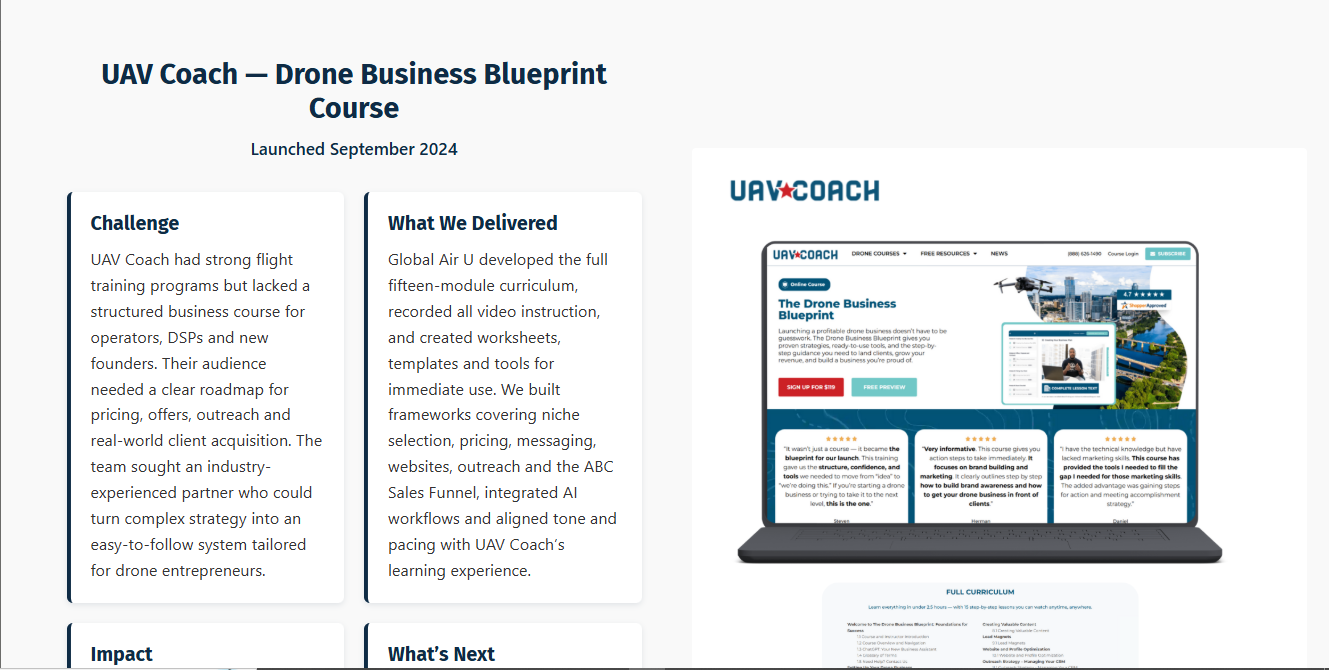
A case study example from Global Air U.
GAU developed the Case Study OS, Case Study Operating System specifically because drone operators were being told to build case studies without being shown what one should actually contain or look like.
The framework requires only five inputs. From those five inputs, it produces multiple output formats that work across every stage of your sales process.
Here are the five inputs:
INPUT 1 — THE CLIENT CONTEXT
Who is the client? Define their industry, company size, and the operational environment you worked in. You do not need to name them if confidentiality is a concern — the sector and scale are what matter.
Example: Mid-size commercial construction firm managing a 14-acre mixed-use development site in the Southeast US.
INPUT 2 — THE PROBLEM
What specific challenge were they facing before you came in? Ground this in operational or financial terms, not drone terminology.
Example: The site supervisor was managing five subcontractor disputes per month over earthwork quantities. Manual surveying was taking three days per cycle and delaying reporting to the project owner by two weeks.
This is where most case studies fail. Drone operators describe what they did before they describe what the client needed. Enterprise buyers read the problem section first. If it does not sound like their problem, they stop reading.
INPUT 3 — YOUR SOLUTION
What did you deliver? Be specific. Include the equipment used, the methodology, the turnaround time, and what made your approach distinct from a standard site visit.
Example: Weekly orthomosaic capture and cut-fill volume reporting delivered within 24 hours of each flight, using ground control points for sub-centimeter accuracy.
Notice the solution describes outputs, not the drone. The drone is your tool, not your product.
INPUT 4 — THE MEASURABLE RESULTS
This is the most important section of any enterprise case study. Quantify everything you can.
Results that enterprise clients respond to:
- Time saved — from days to hours
- Cost reduced — compared to previous method or vendor
- Coverage increased — area mapped vs. manual baseline
- Disputes resolved or prevented — using your data
- Reporting cycle shortened — days removed from approval timelines
- Safety incidents avoided — field crew hours reduced
If you have one strong number, lead with it. A case study that opens with "reduced site reporting time by 68%" earns a second read from every project manager in that room.
INPUT 5 — THE CLIENT VOICE
One direct quote from the client. It does not need to be long. A single sentence that confirms the result in their own words carries more credibility than three paragraphs of your own analysis.
If the client is not comfortable being named, you can attribute the quote to their role and sector.
Example: "We used to spend three days arguing over quantities. Now we pull up the report and the conversation is over in ten minutes." - Construction Project Manager, Southeast US
THE THREE FORMATS EVERY CASE STUDY NEEDS
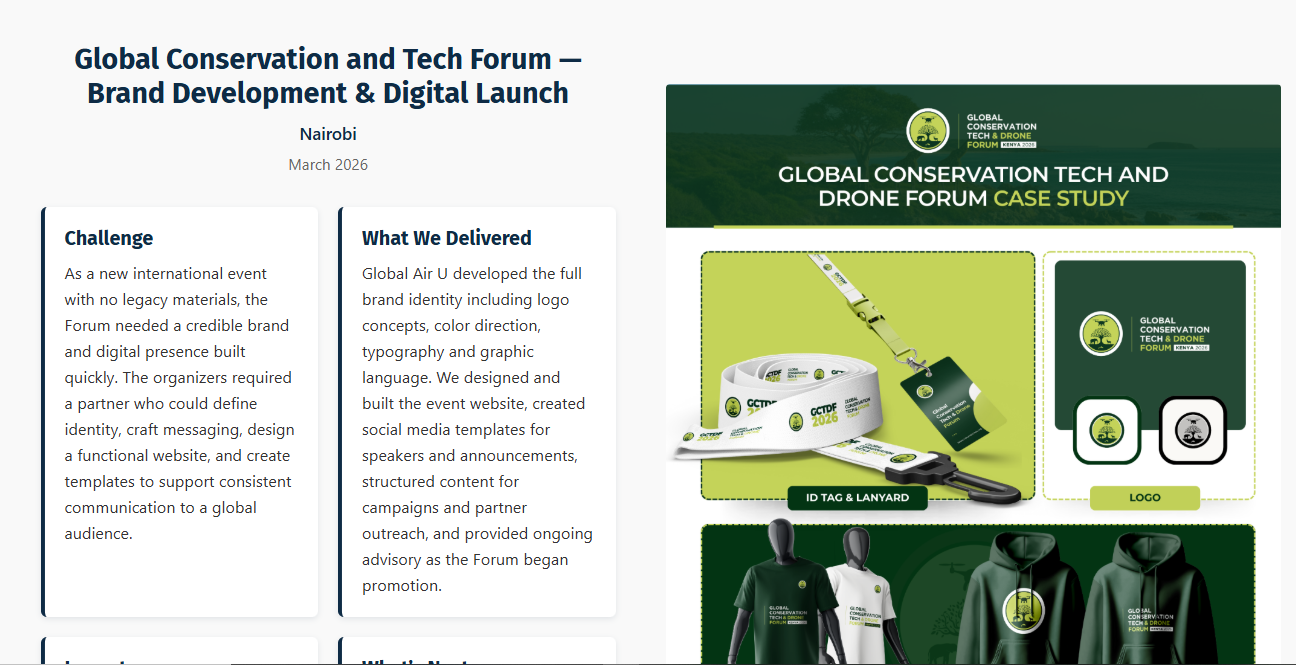
A case study example from Global Air U.
Once you have your five inputs, you do not produce one case study. You produce three versions, each built for a different stage of the sales process.
FORMAT 1 — THE SHORT SUMMARY (50–75 words)
This lives on your website, in your email signature, and at the top of your proposals. It is scannable and outcome-focused. Enterprise buyers decide in the first 30 seconds whether they want to read further.
FORMAT 2 — THE FULL NARRATIVE (800–1,000 words)
This is the version you send after an initial meeting. It reads like a professional project brief — structured, detailed, and written to be forwarded internally. This is what the operations director sends to procurement when they are building the case to hire you.
FORMAT 3 — THE PITCH DECK SLIDE (1 slide)
Three elements: the problem in one sentence, the result in one number, the client quote. This slide does more work in a 30-minute enterprise presentation than any five slides of service descriptions.
GAU's Drone Project Report Template gives you the professional framework to build all three versions from the same project data, formatted and ready to drop into any proposal, pitch deck, or website page.
HOW MANY CASE STUDIES DO YOU NEED?
One strong case study per vertical you actively pursue is enough to begin. If you are targeting construction, infrastructure, and utilities, that is three case studies. Each one should feature a result that is specific to the pain points of that sector.
Do not spread your case studies thin by trying to cover every possible application. Enterprise buyers want to see that you have solved their specific problem before. One case study with a 68% time reduction in construction reporting is worth more than ten generic project summaries across six different industries.
As you complete more work, build more. The goal is a rotating library of sector-specific proof that makes every pitch feel inevitable.
READY TO PACKAGE YOUR DRONE PROJECTS INTO PROOF THAT CLOSES?
GAU's Drone Project Report Template gives you a professional, client-ready framework to document any completed project, iinspection, mapping, or survey, and turn it into a case study that works in pitches, proposals, and on your website.
→ Get the Drone Project Report Template:
globalairu.com/resource_redirect/landing_pages/2149764450